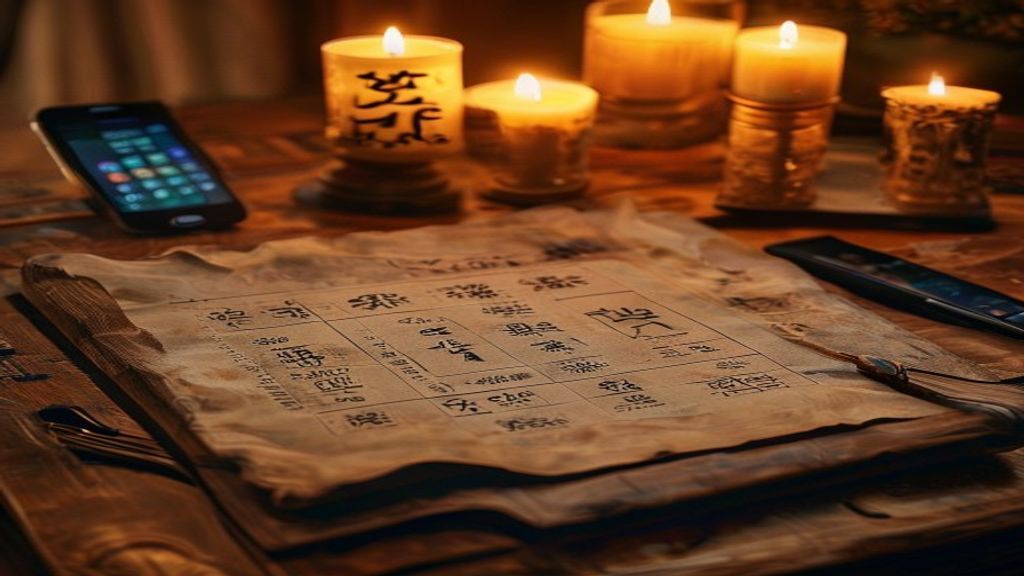
What Is a Korean Saju Calculator — and Why Is Everyone Talking About It?
If you've spent any time scrolling through Korean drama forums or K-pop fan communities, you've probably come across the word saju (사주). Maybe a character pulled out a fortune teller's business card, or you saw a friend post their "four pillars" reading on social media. Whatever brought you here, you're not alone — millions of people search for a free Korean saju calculator online every month.
But what exactly is saju, and does an online calculator actually give you meaningful results? This guide breaks it all down: the history, the mechanics, how to use a free tool, and what to realistically expect from your reading.
---
The History Behind Saju: A 2,000-Year-Old System
Saju (사주, literally "four pillars") is a classical East Asian system of destiny analysis rooted in Chinese metaphysics. It arrived on the Korean peninsula around the Three Kingdoms period (roughly 57 BCE–668 CE) and was woven deeply into Korean court culture by the Goryeo and Joseon dynasties.
From Royal Courts to Everyday Life
During the Joseon Dynasty (1392–1897), saju readings were practically mandatory for major life decisions. Aristocratic families consulted sajujaengi (사주쟁이) — professional saju interpreters — before arranging marriages, naming children, choosing burial sites, and launching businesses. The emperor's court maintained official astrologers whose job was partly to analyze the four pillars of state officials.
Fast-forward to today, and the tradition hasn't disappeared. It's just gone digital. A 2023 survey by a Korean cultural research institute found that nearly 60% of Koreans in their 20s and 30s had consulted some form of fortune analysis in the past year — and online saju calculators were among the most popular tools.
Why "Four Pillars"?
The name refers to the four columns of a person's birth data:
- Year Pillar — the year you were born
- Month Pillar — the month you were born
- Day Pillar — the day you were born
- Hour Pillar — the hour you were born
---
How Does Saju Actually Work?
Understanding the mechanics makes your calculator results far more meaningful than just reading a generic horoscope.
The Ten Heavenly Stems (천간, Cheon-gan)
These are the ten cyclical symbols tied to the five elements — Wood, Fire, Earth, Metal, and Water — each appearing in both a Yin and Yang form:
- 갑 (Gab) — Yang Wood
- 을 (Eul) — Yin Wood
- 병 (Byeong) — Yang Fire
- 정 (Jeong) — Yin Fire
- 무 (Mu) — Yang Earth
- 기 (Gi) — Yin Earth
- 경 (Gyeong) — Yang Metal
- 신 (Sin) — Yin Metal
- 임 (Im) — Yang Water
- 계 (Gye) — Yin Water
The Twelve Earthly Branches (지지, Jiji)
You likely recognize these as the twelve animals of the Chinese zodiac — Rat, Ox, Tiger, Rabbit, Dragon, Snake, Horse, Goat, Monkey, Rooster, Dog, and Pig. In saju, they carry deeper elemental and seasonal meanings beyond personality descriptions.
The Interaction of Elements
This is where saju gets genuinely complex. The five elements interact through two cycles:
- Generating Cycle: Wood feeds Fire, Fire creates Earth (ash), Earth produces Metal, Metal holds Water, Water nourishes Wood.
- Controlling Cycle: Wood breaks up Earth, Earth dams Water, Water extinguishes Fire, Fire melts Metal, Metal chops Wood.
---
What a Free Korean Saju Calculator Online Gives You
A free online saju calculator automates the first and most technical step: converting your Gregorian birth date and time into the traditional Korean/Chinese calendar and generating your four pillars chart.
What You'll Typically Input
- Birth year, month, and day
- Birth hour (as specific as possible — some use two-hour blocks)
- Sometimes gender (certain interpretive traditions factor this in)
- Birth location (some advanced tools adjust for longitude)
What You'll Get Back
Most free calculators display:
- Your four pillars in Hanja (Chinese characters) and Hangul
- Your dominant element(s) and their balance
- Your Day Master — the Heavenly Stem of your Day Pillar, considered your core self
- Basic personality and tendency descriptions
- Luck pillars (대운, daeun) — ten-year cycles that show life phases
- Annual luck (세운, seun) — the energetic flavor of each calendar year
The Limitation of Free Tools
Here's an honest caveat: automated calculators are excellent for chart generation, but interpretation is genuinely complex. Think of it like getting an MRI scan — the machine can produce the image, but you still need a trained eye to read it fully. Free tools provide a solid foundation; deep personal readings benefit from human expertise.
---
How to Read Your Saju Results: A Beginner's Walkthrough
Getting your chart is only half the journey. Here's how to start making sense of it.
Step 1: Find Your Day Master
Look at the top character in your Day Pillar. This is your Day Master — arguably the single most important element in saju. It represents your core identity, natural strengths, and fundamental energy.
For example, if your Day Master is 갑 (Gab, Yang Wood), you tend to be ambitious, growth-oriented, and sometimes stubborn — like a tall oak tree pushing upward.
Step 2: Assess Elemental Balance
Count how many of the five elements appear across your eight characters. A chart with four Water characters and no Fire might suggest emotional depth but a tendency toward overthinking or lack of decisive energy. This is where the concept of yong-sin (용신) — your "useful god" or needed element — becomes important. Your needed element is what your chart lacks and what you can consciously cultivate.
Step 3: Check Your Current Luck Pillar
Every person moves through a series of ten-year luck cycles starting at a specific age (calculated from birth date and season). Your current luck pillar interacts with your natal chart to shape the general themes of this decade. If the incoming element is your needed element, it's typically a supportive period.
Step 4: Look at the Annual Luck
Each calendar year carries its own Heavenly Stem and Earthly Branch. In 2025, for instance, we're in the Year of the Wood Snake (을사년). How this year's energy interacts with your natal chart influences the specific texture of this particular year for you personally.
---
Saju vs. Western Astrology: Key Differences
Many Western readers approach saju through the lens of astrology, so it helps to understand what sets them apart.
| Feature | Saju (Four Pillars) | Western Astrology | |---|---|---| | Base system | Solar/Lunar calendar cycles | Tropical zodiac (Sun's position) | | Key input | Exact birth date + time | Birth date, time, and place | | Core unit | Day Master (self-element) | Sun sign | | Time cycles | 10-year luck pillars | Transits, progressions | | Emphasis | Elemental balance, destiny timing | Planetary archetypes | | Cultural origin | Chinese/East Asian metaphysics | Greco-Roman-Babylonian tradition |
Neither system is superior — they simply use different lenses. Many people find that reading both together offers a richer, more nuanced self-understanding.
---
Saju in Modern Korean Culture: Not Just Superstition
It would be a mistake to dismiss saju as a relic of pre-modern Korea. It's thriving — and in some ways, it's more mainstream than ever.
The K-Drama Effect
Shows like Mr. Queen, Arang and the Magistrate, and numerous others have brought traditional fortune-telling practices to global audiences. Watching a character receive a saju reading and then seeing that prediction play out across twenty episodes is genuinely compelling storytelling — and it sends curious viewers straight to online calculators.
Saju as a Dating Filter
In South Korea today, it's not unusual for someone to ask a potential romantic partner for their birth date and time fairly early in dating — not to be rude, but to check for gunghap (궁합), or compatibility. Think of it as the Korean equivalent of asking someone's Myers-Briggs type, except with a 2,000-year pedigree. Apps that combine saju compatibility with modern dating profiles have become genuinely popular among younger Koreans.
Corporate and Career Planning
Some Korean entrepreneurs and executives openly consult saju readers before major business decisions — launching a company, choosing a business partner, or timing a product release. This blend of pragmatic modernity and traditional wisdom is distinctly Korean and reflects a broader cultural comfort with holding both rational and intuitive frameworks at once.
---
Tips for Getting the Most from a Free Saju Calculator
Here are practical suggestions to maximize your experience:
- Know your exact birth time. This is the most common source of inaccuracy. If you don't know it, check your birth certificate or ask family. Without it, some calculators will default to noon, which may give you incorrect Hour Pillar results.
- Try more than one tool. Different free calculators use slightly different algorithms or interpretive databases. Comparing two or three results helps you see what's consistent.
- Focus on the Day Master first. Don't try to absorb everything at once. Start with understanding your Day Master, then gradually expand outward.
- Take personality descriptions with nuance. No system captures a full human being in eight characters. Use descriptions as prompts for self-reflection, not absolute verdicts.
- Note your current luck pillar. Understanding the ten-year cycle you're in often explains a lot about why a particular period feels the way it does.
- Learn the basics before diving deep. Even a short introduction to the five elements and their relationships will make your reading dramatically more meaningful.
What Traditional Saju Readers Say About Online Calculators
Interesting tension exists here. Most professional saju readers — particularly those trained in the traditional Korean school of thought — acknowledge that online calculators do the chart generation accurately. The math, after all, is math.
Where they push back is on interpretation. A seasoned reader considers the strength of each element given the season of birth (spring-born Wood is different from winter-born Wood), the specific combinations and clashes between pillars, and the context of a person's lived experience. These nuances are difficult to encode in an algorithm.
The consensus from practitioners tends to be: free calculators are a great starting point and a valuable learning tool. For major life decisions, a consultation with a knowledgeable human reader adds depth that no app can fully replicate — just as you'd use a health app for general wellness tracking but still see a doctor for a diagnosis.
---
Frequently Asked Questions About Free Saju Calculators
Is saju the same as BaZi? Essentially yes. BaZi (八字) is the Chinese term; saju (사주) is the Korean pronunciation of the same characters. The systems share the same foundation but have developed some regional interpretive differences over centuries.
Do I need to know Korean to use a saju calculator? Many free online calculators now offer English-language interfaces and results, particularly those targeting international users. Some Korean-language tools provide very detailed results but require basic Korean reading ability or a translation tool.
Can saju predict specific events? Saju identifies energetic tendencies, favorable and challenging timing periods, and natural strengths and weaknesses. It doesn't predict specific events with certainty — and any practitioner claiming otherwise should be approached with skepticism.
What if I don't know my birth time? You can still generate a partial reading using year, month, and day pillars. The Hour Pillar will be missing or estimated, which limits accuracy somewhat, but the other three pillars still contain substantial information.
Is saju only for Koreans? Not at all. The underlying system is pan-East Asian, and people from all cultural backgrounds engage with it. Cultural context enriches the experience, but curiosity is the only real requirement.
---
Start Exploring Your Four Pillars Today
Whether you're a curious first-timer who just finished a Korean drama, someone with genuine interest in East Asian philosophy, or a seasoned astrology enthusiast looking to expand your toolkit — a free Korean saju calculator is an accessible, fascinating entry point.
The depth of this tradition rewards patient exploration. Start with your Day Master. Learn the five elements. Understand the luck cycles. Over time, you'll find that your chart becomes a surprisingly useful mirror for self-reflection — not a cage, but a map.
If you find yourself hungry for more after your first reading, there's a rich world of Korean cultural wisdom to explore: from traditional holidays like Chuseok and Seollal, where ancestral reverence meets the living calendar, to the art of Korean pungsu (geomancy) and the deep symbolism woven through Korean food, clothing, and architecture. Saju is just one thread in a remarkable cultural tapestry.
Look for reputable Korean cultural blogs, language learning resources, and community forums where practitioners and enthusiasts discuss interpretations openly — the global community around East Asian metaphysics is welcoming, knowledgeable, and growing fast.