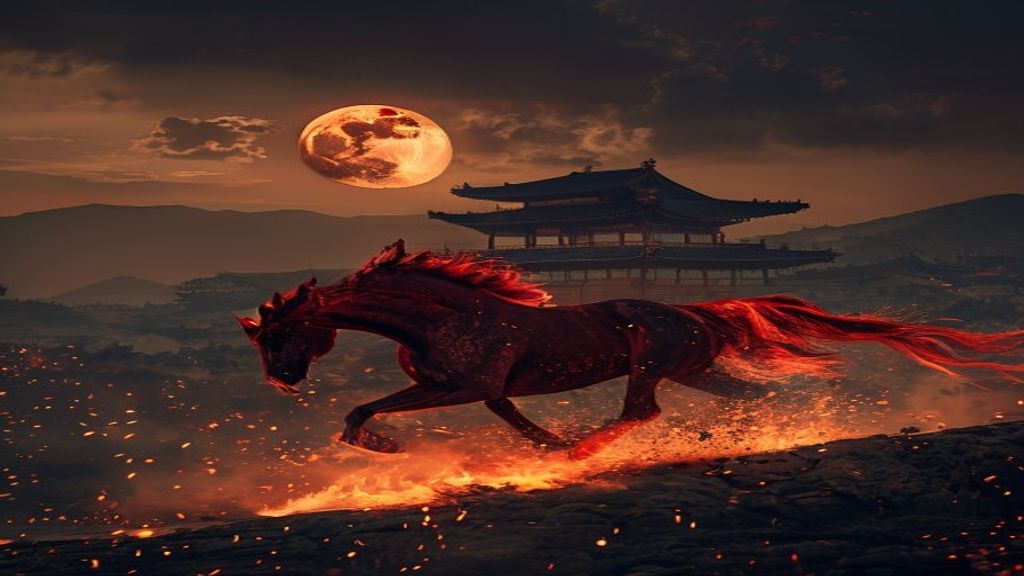
What Is the Year of the Red Fire Horse in Korean Astrology?
If you've ever glanced at a Korean lunar calendar or chatted with a Korean grandmother about fate, you've probably encountered the concept of the sigan — the cycle of time that governs fortune, personality, and destiny. In 2026, that ancient system delivers one of its most electrifying years: Byeong-o (병오년), the Year of the Red Fire Horse.
This isn't just a zodiac label. In Korean traditional thought, each year carries a layered identity built from two interlocking systems — the Ten Heavenly Stems (Cheongan, 천간) and the Twelve Earthly Branches (Jiji, 지지). When Byeong (丙), the stem associated with Yang Fire, combines with O (午), the branch representing the Horse, the result is an explosive, luminous, and relentlessly driven year unlike almost any other in the 60-year cycle.
The last time this combination appeared was 1966 — and Korean folklore has long treated Fire Horse years with a mix of awe and caution. Let's unpack what 2026 really means for those who follow Korean astrological traditions.
---
Understanding Byeong-o: The Sixty-Year Cycle Explained
The Sexagenary Cycle (Yukgapja, 육갑자)
Korean traditional timekeeping relies on a 60-year cycle created by pairing 10 Heavenly Stems with 12 Earthly Branches. Each combination is unique — meaning your birth year's energy only repeats once in a lifetime. This is why Koreans celebrate hwangap (환갑), the 60th birthday, as such a momentous milestone: you've completed one full revolution of cosmic time.
2026 marks the 43rd year in the current cycle that began in 1984. The Byeong-o combination arrives carrying the full force of Yang Fire energy doubled — because the Horse itself is associated with Fire in the five-element system (ohaeng, 오행).
Fire on Fire: What That Double Energy Means
In Korean metaphysics, Fire (hwa, 火) governs:
- Passion, creativity, and visibility
- Leadership and charisma
- Rapid transformation — sometimes volatile
- The heart, circulation, and the south direction
---
The Horse in Korean Culture: More Than a Zodiac Symbol
Historical Significance of the Horse (Ma, 말)
The horse holds a deeply respected place in Korean history. During the Goryeo dynasty (918–1392), horses were central to military power and the famous Mongol-influenced cavalry that shaped the peninsula's political fate. Jeju Island developed its own indigenous horse breed — the Jeju horse (jejuma, 제주마) — which remains a living symbol of endurance and wild spirit today.
In shamanistic traditions (musok, 무속), horses frequently appear as spirit animals carrying messages between the human and divine worlds. Shamans (mudang) sometimes perform rituals involving horse imagery to invoke swiftness, guidance, and protective energy.
The Horse Personality in Korean Zodiac
People born in Horse years are traditionally described as:
- Energetic and independent — they resist being fenced in
- Charismatic communicators with natural leadership
- Impatient and prone to acting on instinct
- Adventurous — often the first to try something new
- Loyal in love but fiercely protective of their freedom
---
The Red Fire Horse Year: A Historically Charged Combination
Why Byeong-o Years Carry Such Weight
In both Korean and broader East Asian astrological tradition, the Red Fire Horse year is considered one of the most powerful — and most demanding — in the entire 60-year cycle. Japanese astrology famously led to a dramatic birth rate drop in 1966 due to superstitions about Fire Horse women. Korea had its own cultural ripple, though generally less extreme.
The concern wasn't malice — it was a recognition that Fire Horse energy is simply too much for the average year. Those born in Byeong-o years are said to burn brilliantly but risk consuming everything around them, including themselves. This perception has softened in modern Korea, but many saju practitioners still note that Byeong-o carries an intensity that requires conscious management.
1966 vs. 2026: A Changed Korea
The last Byeong-o year, 1966, arrived during a period of rapid industrialization under Park Chung-hee's government. Korea was bootstrapping itself from post-war poverty into economic ambition. The Fire Horse energy arguably mirrored the national spirit: relentless, transformative, occasionally reckless.
In 2026, Korea enters Byeong-o as a global cultural and technological powerhouse — from K-pop and K-drama dominating streaming platforms to Samsung and Hyundai reshaping industries worldwide. The Fire Horse's energy now has an entirely different stage to perform on.
---
2026 Korean Astrology Forecast: The Big Themes
Collective Energy for the Year
Korean astrologers and saju practitioners typically identify several overarching themes that the year's energy shapes for everyone, regardless of individual birth charts.
For 2026, the dominant themes are:
- Breakthrough momentum: Projects that have been slowly building will accelerate dramatically. The Fire Horse doesn't wait.
- Visibility and recognition: This is a year where talent surfaces — hiding your abilities will become uncomfortable.
- Relationship intensity: Romantic and professional partnerships will face heat. Strong bonds deepen; fragile ones fracture.
- Financial volatility: Fire years often bring quick gains and equally quick reversals. Caution with speculation is advised.
- Health focus — especially cardiovascular: Traditional Korean medicine (hanbang, 한방) correlates Fire energy with the heart. Managing stress and stamina becomes crucial.
Areas of National and Global Significance
From a broader gi (기, energy/qi) perspective, 2026 may bring:
- Significant leadership transitions or political reshaping
- Technological breakthroughs, particularly in energy and communications (Fire governs both light and electricity in metaphorical terms)
- Cultural moments that feel historic — the kind you remember exactly where you were for
2026 Fortune by Korean Zodiac Sign
In Korean astrology, your birth year's animal sign interacts with the year's energy in specific ways. Here's a general overview — remember that a full saju reading incorporates your birth month, day, and hour for true accuracy.
Highly Favorable Signs in 2026
Tiger (인, 寅) — Tiger and Horse share a harmonious triad in Korean astrology. 2026 brings Tigers unexpected opportunities and social expansion. Lean into new connections.
Dog (술, 戌) — Another member of the Fire triad, Dogs benefit from the year's energy aligning with their natural temperament. Career advancements are likely for those who take initiative.
Sheep/Goat (미, 未) — While not in the Fire triad, Sheep form a beneficial combination with Horse energy. Creative endeavors and love prospects shine especially bright.
Signs Requiring Extra Care
Rat (자, 子) — Water versus Fire creates friction. Rats may find 2026 demanding — particularly in workplace hierarchies. Patience and strategic thinking are essential.
Ox (축, 丑) — Ox and Horse sit in direct opposition in the zodiac wheel, a configuration called chungsal (충살). Major life changes are possible; avoid forcing situations.
Horse (오, 午) — When the year matches your birth sign, Korean tradition calls this beonnyeon (본년) or taesalnyeon — a year of both potential and instability. Horses should be especially mindful of health and avoid major financial risks in the first half.
Neutral but Watchful Signs
Rabbit, Snake, Monkey, Rooster, Pig, Dragon — These signs generally experience a mixed year. Individual saju charts will determine whether 2026 tilts positive or challenging for specific birth chart compositions.
---
Korean Traditions and Rituals for Navigating a Fire Horse Year
Consulting a Saju Reader
Many Koreans — from teenagers to CEOs — visit a saju master at the start of each new lunar year. In 2026, the Lunar New Year falls on February 17th. This is traditionally when new forecasts are sought. Whether at a traditional jeomjip (점집, fortune house) in a neighborhood alley or via a modern app, the practice of checking your fortune remains deeply embedded in Korean life.
One Seoul-based professional described her annual saju consultation as "less about believing every word and more about having a framework for reflection — what do I want to protect this year, and what am I willing to risk?"
Seollal Rituals for Good Fortune
During Seollal (설날), the Korean Lunar New Year, families perform charye (차례) — ancestral memorial rites — and eat tteokguk (떡국, rice cake soup) to symbolically gain a year of age and good fortune. In a Fire Horse year, traditional saju practitioners may recommend:
- Wearing red or orange to harmonize with the Fire energy rather than fight it
- Placing water elements in the home (aquariums, fountains) to balance excessive Fire
- Making offerings at local Buddhist temples or shamanic shrines for protection during a high-intensity year
- Avoiding major construction or moving homes in the early months while the year's energy settles
Protective Talismans (Bujeok, 부적)
In Korean folk tradition, bujeok — red-ink talismans written on yellow paper — are used to ward off bad energy or invite specific fortunes. For Fire Horse years, talismans involving water imagery (dragons, waves, the color blue) are sometimes recommended to prevent the year's intensity from overwhelming personal luck.
---
Modern Korean Perspectives on Traditional Astrology
Is It Still Relevant?
Absolutely — perhaps more than ever. South Korea's astrology and fortune-telling industry is estimated to generate billions of won annually, with younger generations actually driving growth. Saju apps have millions of downloads; MZ generation (Millennials + Gen Z) Koreans casually reference their saju in dating conversations the way Westerners might mention their MBTI.
The appeal isn't blind superstition. For many modern Koreans, saju functions as:
- A self-reflection tool grounded in centuries of psychological observation
- A cultural connector to ancestors and traditional wisdom
- A risk-awareness framework in a high-pressure, fast-moving society
K-Drama and Pop Culture Connections
Korean dramas and films regularly incorporate saju and zodiac themes — from romantic comedies where characters check compatibility charts before dating to historical dramas where royal advisors read the stars before battles. The 2026 Fire Horse energy will almost certainly inspire new creative works exploring themes of ambition, fate, and transformation.
---
Practical Takeaways for 2026: Working With Fire Horse Energy
Regardless of whether you follow Korean astrology closely or are simply curious, the thematic framework of Byeong-o offers genuinely useful guidance:
Embrace boldness, but plan your exits: Fire Horse years reward those who act decisively. But having contingency plans prevents the impulsiveness that this energy can trigger.
Invest in health and recovery: With intensity comes depletion. Build rest into your schedule deliberately — the Korean concept of nunchi (눈치, reading the room) applies to reading your own energy levels too.
Let relationships evolve: The heat of a Fire Horse year accelerates relationship timelines. Don't resist meaningful change in how you connect with others.
Channel creativity outward: If there's a project, passion, or idea you've been holding back — 2026 is genuinely the year Korean tradition would say to release it into the world.
---
Final Thoughts: Riding the Fire Horse in 2026
The Year of the Red Fire Horse is not a year for the faint-hearted — but it's also not a year to fear. Korean astrological tradition has always framed these intense cycles not as punishments but as invitations: to grow faster, shine brighter, and confront what you've been avoiding.
Whether you're Korean by birth, by heart, or simply fascinated by the depth of East Asian cultural wisdom, Byeong-o 2026 offers a compelling lens through which to examine your own ambitions, relationships, and choices.
The Fire Horse doesn't wait at the gate. It's already running.
---
Curious to go deeper? Explore resources on Korean saju astrology, the lunar calendar traditions of Seollal, and the rich world of Korean shamanic (musok) culture — all of which illuminate why 2026 is a year worth understanding on its own terms.